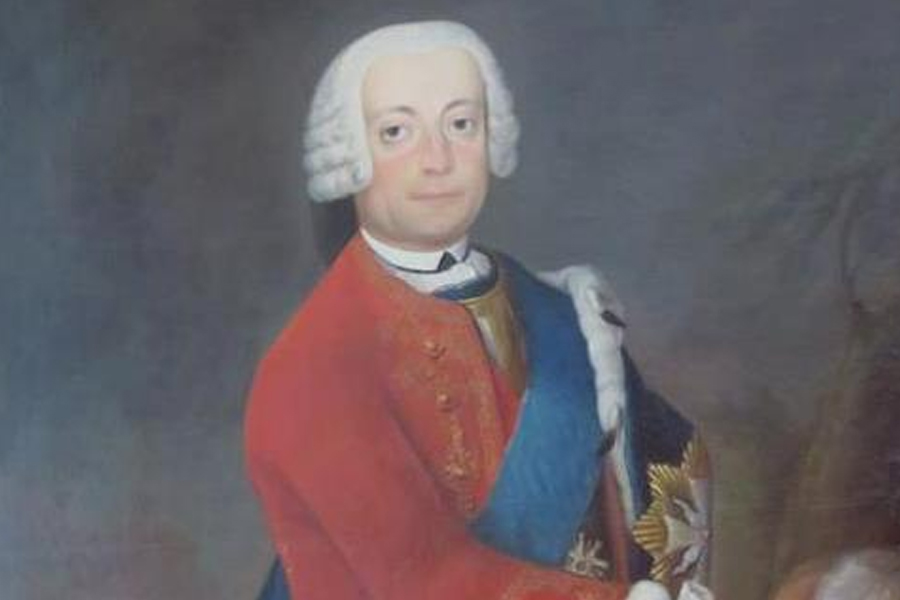
Basic Information
| Field | Details |
|---|---|
| Full Name | Duke Charles Louis Frederick Of Mecklenburg (German: Carl Ludwig Friedrich von Mecklenburg-Strelitz) |
| House | House of Mecklenburg, Strelitz (Mirow branch) |
| Birth | 23 February 1708, Strelitz, Duchy of Mecklenburg-Strelitz |
| Death | 5 June 1752, Mirow |
| Father | Adolphus Frederick II, Duke of Mecklenburg-Strelitz |
| Mother | Princess Christiane Emilie of Schwarzburg-Sondershausen |
| Spouse | Princess Elisabeth Albertine of Saxe-Hildburghausen (m. 5 February 1735) |
| Issue (notable) | Charles II (1741–1816); Ernest Gottlob (1742–1814); Sophia Charlotte (1744–1818, later Queen Charlotte of Great Britain); others died young |
| Titles/Style | Duke of Mecklenburg (by dynastic right); Prince of the Mirow line |
| Notable Legacy | Father of Queen Charlotte; progenitor of a line that would link Mecklenburg-Strelitz to the thrones of Britain, Prussia, and Hanover |
Origins in a Partitioned Land
The life of Duke Charles Louis Frederick Of Mecklenburg unfolds against a map already cleaved in two. In 1701, the House of Mecklenburg split into the Schwerin and Strelitz branches, a political compromise that created parallel duchies within the Holy Roman Empire. Born in 1708 to Adolphus Frederick II—founder of the Strelitz line—and Princess Christiane Emilie of Schwarzburg-Sondershausen, Charles Louis Frederick grew up as a younger son in a junior branch. His world was Mirow: a lakeside seat, a practical court, and a training ground for duty without the limelight.
The Mirow branch carried the ducal style but not the sovereign throne. That distinction did not narrow his horizon. In 1735, he married Princess Elisabeth Albertine of Saxe-Hildburghausen, a union that stitched his modest court into the wider fabric of German principalities. Their household balanced the quiet rituals of a small German principality with the rigorous education required of princes who might one day be called upon to do more than they imagined.
Marriage, Household, and the Mirow Line
The marriage to Elisabeth Albertine proved dynastically shrewd. From 1735 onward, Mirow was not just a residence—it was a nursery of future influence. Their children received a disciplined, cosmopolitan upbringing. The family library, tutors, and a steady cadence of courtly protocol framed a childhood oriented toward service: Lutheran piety, proficiency in French and German, and the arts of correspondence and diplomacy.
As a ducal prince, Charles Louis Frederick did not reign; he sustained. He managed estates, supervised household obligations, and moved within the network of German courts that communicated by letter, matrimonial alliance, and carefully brokered favors. He was the kind of prince a confederation like the Holy Roman Empire needed: dependable, dutiful, prepared.
A Family That Would Touch Crowns
From this compact court came a long echo. Three children are especially notable:
- Charles II (1741–1816): He would become Duke of Mecklenburg-Strelitz in 1794 and Grand Duke in 1815, his fortunes rising with the reshaping of Europe at the Congress of Vienna.
- Ernest Gottlob (1742–1814): A steadfast cadet of the house, he served his dynasty without marriage, a loyal presence in a volatile century.
- Sophia Charlotte (1744–1818): The poised, well-educated princess who would become Queen Charlotte, consort to George III of Great Britain, and one of the period’s most consequential cultural patrons.
A single marriage—Charlotte’s to King George III in 1761—radiated across Europe like ripples from a stone tossed into still water. It brought botanical gardens into bloom, fueled musical patronage (think Haydn and the Handelian tradition), and tethered a modest German house to global history.
Widowhood and Regency: Elisabeth Albertine’s Steady Hand
Charles Louis Frederick died on 5 June 1752, only 44 years old. His death coincided with a turning point in Strelitz. That December, the reigning duke, Adolphus Frederick III, also died, leaving an underage successor. For a brief but vital period (1752–1753), Elisabeth Albertine, Charles’s widow, acted as regent and guardian of the state’s interests. Her task was simple to state yet complex to execute: preserve stability, protect prerogatives, and ready the next generation. She succeeded—an essential bridge from one era to the next, guiding both her son’s prospects and her daughter’s reputation.
The Mirow Line Ascends
The long arc of dynastic fortune bent toward Mirow. In 1794, when Adolphus Frederick IV died without surviving male issue, Charles II—son of Duke Charles Louis Frederick Of Mecklenburg—succeeded as Duke of Mecklenburg-Strelitz. After the tumults of the Napoleonic era, the Congress of Vienna in 1815 elevated Mecklenburg-Strelitz to a Grand Duchy, and Charles II became its first Grand Duke. In just over six decades, the Mirow line had traveled from quiet cadets of a divided duchy to sovereign princes recognized among Europe’s rebalanced powers.
Kin Networks: The Web Grows Wider
The Mecklenburg-Strelitz family increasingly resembled a well-tended vine, climbing across palaces and frontiers. Through Charles II, the house linked to Prussia and Hanover. Two of his daughters—granddaughters of Charles Louis Frederick—would become queens: Louise of Prussia (1776–1810), beloved consort of Frederick William III, and Frederica of Hanover (1778–1841), consort to Ernest Augustus I. This makes the Mirow line a nexus where British, Prussian, and Hanoverian destinies overlapped.
Royal Connections at a Glance
| Person | Lifespan | Role/Connection |
|---|---|---|
| Sophia Charlotte of Mecklenburg-Strelitz | 1744–1818 | Queen consort of Great Britain and Ireland (m. George III, 1761) |
| Charles II of Mecklenburg-Strelitz | 1741–1816 | Duke (1794–1815), Grand Duke (1815–1816) |
| Louise of Prussia (granddaughter) | 1776–1810 | Queen consort of Prussia, symbol of national resistance |
| Frederica of Hanover (granddaughter) | 1778–1841 | Queen consort of Hanover |
| Ernest Gottlob of Mecklenburg | 1742–1814 | Ducal prince, dynastic supporter, unmarried |
A Century in Timelines
The scaffold of dates can feel austere, but here it sings with consequence:
| Year | Event |
|---|---|
| 1701 | Partition of Mecklenburg into Schwerin and Strelitz |
| 1708 | Birth of Charles Louis Frederick in Strelitz (23 February) |
| 1735 | Marriage to Princess Elisabeth Albertine of Saxe-Hildburghausen (5 February) |
| 1741 | Birth of Charles II in Mirow (10 October) |
| 1742 | Birth of Ernest Gottlob (27 August) |
| 1744 | Birth of Sophia Charlotte in Mirow (19 May) |
| 1752 | Death of Charles Louis Frederick in Mirow (5 June) |
| 1752–1753 | Regency of Elisabeth Albertine in Mecklenburg-Strelitz |
| 1761 | Marriage of Charlotte to George III (8 September) |
| 1794 | Charles II becomes Duke of Mecklenburg-Strelitz |
| 1815 | Elevation of Strelitz to Grand Duchy; Charles II becomes Grand Duke |
| 1816 | Death of Charles II (6 November) |
Character and Legacy
Contemporaries saw in Duke Charles Louis Frederick Of Mecklenburg a careful steward rather than a conqueror—an oak in a forest of poplars. His was a quieter form of statecraft: train the mind, fortify the household, cultivate alliances. He did not wear a crown, but he fathered one, and his line multiplied thrones. The Mirow court’s emphasis on education and prudence shaped Charlotte’s equanimity and the later steadiness of Charles II, whose brief grand ducal reign capped a lifetime of preparation.
If Mecklenburg-Strelitz appears modest on the map, its family strategy was anything but small. From Mirow’s lakes to London’s palaces, from the altars of Strelitz to the courts of Prussia and Hanover, this lineage performed the slow alchemy that turns local duty into continental influence.
FAQ
Was Duke Charles Louis Frederick Of Mecklenburg a reigning duke?
No; he held the ducal style as a prince of the Mirow branch but never reigned as the sovereign duke.
Who was his most famous child?
His daughter Sophia Charlotte became Queen Charlotte, consort to King George III of Great Britain.
Did his widow serve as a regent?
Yes; Princess Elisabeth Albertine acted as regent of Mecklenburg-Strelitz during the minority of the new duke in 1752–1753.
How did his line gain the throne of Mecklenburg-Strelitz?
In 1794, the ruling line ended without surviving male heirs, and his son Charles II succeeded as duke.
When was Mecklenburg-Strelitz elevated to a Grand Duchy?
In 1815, at the Congress of Vienna, and Charles II became the first Grand Duke.
Which other royal houses are linked to his descendants?
Through Charles II’s daughters, the family connected to Prussia and Hanover.
Where did he live and die?
He lived largely in Mirow and died there on 5 June 1752.