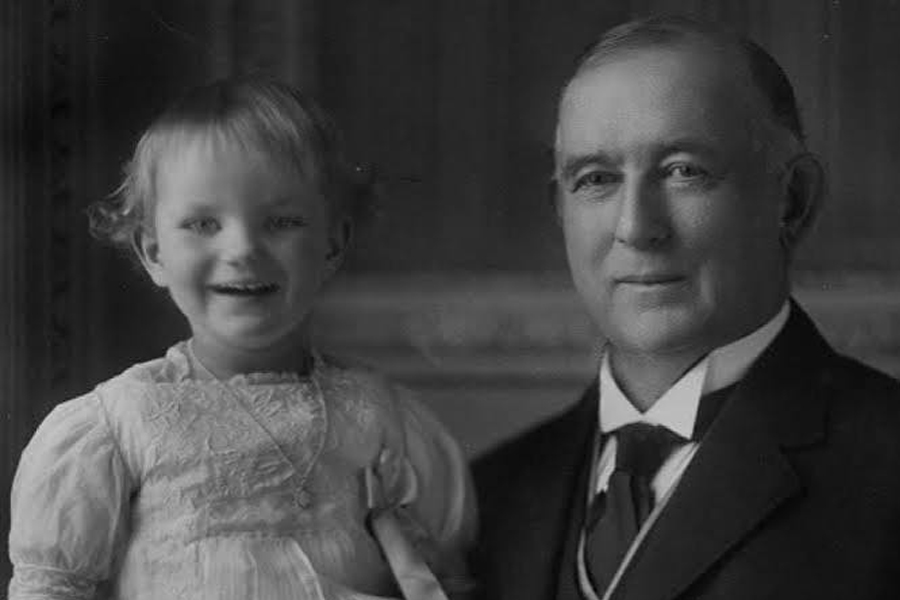
Basic Information
| Item | Details |
|---|---|
| Full Name | James Buchanan “Buck” Duke |
| Born | December 23, 1856 |
| Birthplace | Near Durham, North Carolina |
| Died | October 10, 1925 |
| Age at Death | 68 |
| Occupation | Industrialist, tobacco magnate, philanthropist, electric power pioneer |
| Father | Washington Duke |
| Mother | Artelia “Telia” Roney Duke |
| Spouses | Lillian Fletcher McCredy (1904 to 1906), Nanaline Holt Inman Duke (1907 until his death) |
| Children | Doris Duke |
| Best Known For | American Tobacco Company, Duke Endowment, Duke Power, Duke University legacy |
Growing Up on a Farm That Changed American History
When I think of Buck Duke, I envision a resolute young man standing on a little farm in North Carolina, surrounded by fields rather than wealth. It was unlikely that this child would go on to create one of the biggest industrial empires in American history.
On December 23, 1856, James Buchanan “Buck” Duke was born close to Durham, North Carolina, which was then a part of Orange County. His family was a straightforward Methodist farmer family. There was no sign of wealth.
Almost immediately, life got challenging. When Buck was just two years old in 1858, his mother, Artelia “Telia” Roney Duke, passed away from typhoid disease. His father, Washington Duke, was drafted into Confederate duty during the Civil War, leaving the kids to live with family while the family endured difficult years.
Washington returned home with little more than resolve after the war ended in 1865. Family tales tell of starting again with just fifty cents and two blind mules. The Duke family’s tobacco company gradually developed from its modest origins.
Buck’s official education was somewhat modest. He attended neighborhood academies, briefly attended New Garden School, and then briefly attended Eastman Business College in New York. But his true education took place in curing barns, tobacco warehouses, and sales excursions across the nation.
The Duke Family Tree
Buck belonged to a remarkably influential family whose members helped shape education, business, and philanthropy across the American South.
Parents
| Parent | Lifespan | Notes |
|---|---|---|
| Washington Duke | 1820 to 1905 | Tobacco manufacturer, philanthropist, founder of the Duke business fortune |
| Artelia Roney Duke | 1829 to 1858 | Buck’s mother, remembered for her kindness and integrity |
Washington Duke had previously been married to Mary Caroline Clinton, making Buck part of a blended family.
Siblings
| Name | Relationship | Lifespan |
|---|---|---|
| Sidney Taylor Duke | Half brother | 1844 to 1858 |
| Brodie Leonidas Duke | Half brother | 1846 to 1919 |
| Mary Elizabeth Duke Lyon | Sister | 1853 to 1893 |
| Benjamin Newton “Ben” Duke | Brother | 1855 to 1929 |
Among all his siblings, Ben Duke became Buck’s closest business partner. While Buck expanded the tobacco empire, Ben often managed textile operations and many charitable activities. Their partnership became one of the strongest family collaborations in American business history.
Building the Tobacco Empire
Buck possessed remarkable business instincts.
During the early 1880s, he relocated to New York City to expand W. Duke, Sons and Company beyond the South. At the time, cigarettes were still rolled by hand, making production slow and expensive.
Everything changed in 1885.
Buck secured the rights to use James Albert Bonsack’s revolutionary cigarette rolling machine. The machine produced cigarettes dramatically faster than skilled workers could by hand. Manufacturing costs dropped, production soared, and Buck recognized the opportunity before most competitors.
Within only a few years, his company dominated American cigarette production.
In 1890, at only thirty three years old, Buck organized the American Tobacco Company by merging several major competitors.
The company’s rise was extraordinary.
| Year | Achievement |
|---|---|
| 1885 | Adopted Bonsack cigarette machine |
| 1890 | Founded American Tobacco Company |
| 1900 | Expanded into snuff production |
| 1901 | Expanded into cigar manufacturing |
| 1902 | Helped create British American Tobacco |
The company pioneered aggressive advertising, collectible picture cards, promotional giveaways, and nationwide distribution. Buck transformed cigarettes into a mass market consumer product on an unprecedented scale.
The Monopoly That Sparked Resistance
Success came with controversy.
American Tobacco eventually controlled roughly ninety percent of the American cigarette market. Farmers increasingly depended on one dominant buyer that could dictate prices.
This situation became especially severe in Kentucky and Tennessee’s famous Black Patch region, where dark fired tobacco was grown.
Prices collapsed.
Many growers received only two or three cents per pound, often below the cost of producing the crop. Thousands of farming families struggled financially.
In 1904, tobacco growers organized the Planters’ Protective Association, hoping to negotiate fairer prices by withholding their tobacco from the market.
When negotiations failed, some frustrated farmers turned to violence.
Masked groups known as the Night Riders burned warehouses, destroyed tobacco barns, intimidated growers who sold outside the association, and even occupied towns during nighttime raids.
Several major incidents shocked the nation.
| Event | Year |
|---|---|
| Princeton warehouse raids | 1906 |
| Hopkinsville raid | 1907 |
| Large scale military response | 1907 to 1908 |
Although Buck Duke was never personally involved in these acts, the conflict reflected widespread anger toward the immense market power of American Tobacco.
Growing public concern over monopolies eventually contributed to the landmark 1911 Supreme Court decision ordering the breakup of the American Tobacco Company.
Powering the Carolinas
Buck refused to limit himself to tobacco.
He saw enormous potential in hydroelectric power long before many industrial leaders appreciated electricity’s future.
Working closely with his brother Ben, he acquired extensive water rights along the Catawba River.
Important milestones included:
| Year | Development |
|---|---|
| 1904 | Formation of Catawba Power Company |
| 1905 | Creation of Southern Power Company |
| Later | Growth into Duke Power and eventually Duke Energy |
Hydroelectric stations supplied electricity to hundreds of textile mills, factories, businesses, and communities across the Carolinas. Like rivers carving valleys over centuries, Buck’s investments quietly reshaped the region’s economic landscape.
Marriage and Family Life
Buck married twice.
His first marriage to Lillian Fletcher McCredy began in 1904 but ended in divorce two years later. They had no children.
In 1907 he married Nanaline Holt Inman, a sophisticated Southern widow from Georgia. Their marriage lasted until Buck’s death.
Together they welcomed one child.
Doris Duke
Born on November 22, 1912, Doris Duke became one of the world’s wealthiest heiresses after her father’s death.
Buck adored his daughter.
He wrote affectionate letters, encouraged her curiosity about business, and created an extraordinary environment at Duke Farms in New Jersey. The estate eventually covered more than 2,000 acres, featuring lakes, fountains, gardens, sculptures, and magnificent conservatories. Gardening became one of Buck’s greatest personal passions.
After inheriting much of the family fortune, Doris developed her own philanthropic legacy through the Doris Duke Charitable Foundation.
A Lasting Philanthropic Vision
Late in life, Buck began thinking beyond business success.
On December 11, 1924, he established the Duke Endowment with an initial forty million dollar trust.
His goals were ambitious.
The Endowment supported:
- Colleges and universities
- Hospitals
- Child welfare organizations
- Rural Methodist churches
- Educational opportunities throughout North and South Carolina
After Buck died on October 10, 1925, an additional sixty seven million dollars flowed into the Endowment through his estate.
His generosity transformed Trinity College, which was renamed Duke University in recognition of the family’s extraordinary support.
Even today, the Endowment continues distributing grants that improve education, healthcare, and community services across the Carolinas.
Personal Traits That People Often Miss
The industrial behemoth has a very private man behind it, according to many accounts.
Despite creating the biggest tobacco company in the world, Buck apparently detested smoking cigarettes. Before he started smoking cigars, he spent a large portion of his life chewing tobacco.
Workers at the factory thought he could quickly spot a faulty cigarette box among hundreds.
He also had a few peculiarities.
According to reports, he picked up pins from pavements because he thought they were lucky.
He avoided needless attention and remained fiercely focused on his profession rather than popularity, even though he became extremely wealthy.
His commitment to his family was particularly noteworthy. Throughout their lives, he had a very tight bond with both his brother Ben and father Washington.
Financial Legacy
At the time of his death in 1925, Buck Duke’s estate was valued in the tens of millions of dollars.
Large portions of his fortune were distributed to:
| Beneficiary | Purpose |
|---|---|
| Duke Endowment | Education, healthcare, churches, child welfare |
| Nanaline Duke | Personal inheritance and trusts |
| Doris Duke | Family inheritance and trusts |
| Extended Duke relatives | Various provisions under his will |
Adjusted for modern values, the charitable gifts alone represent billions of dollars in today’s purchasing power.
FAQ
Who was Buck Duke?
Buck Duke was an American industrialist who transformed cigarette manufacturing, founded the American Tobacco Company, helped establish Duke Power, and created the Duke Endowment.
Who were Buck Duke’s parents?
His parents were Washington Duke, a tobacco manufacturer and philanthropist, and Artelia Roney Duke, who died when Buck was only two years old.
Who was Buck Duke’s closest business partner?
His older brother Benjamin Newton “Ben” Duke worked alongside him for decades, managing many textile operations and philanthropic efforts.
Who was Buck Duke’s wife?
Buck married Lillian Fletcher McCredy first, then married Nanaline Holt Inman Duke in 1907. Nanaline remained his wife until his death.
Did Buck Duke have children?
Yes. He had one daughter, Doris Duke, who became one of the world’s wealthiest heiresses and an influential philanthropist.
What was the Black Patch Tobacco Wars?
The Black Patch Tobacco Wars were violent conflicts between tobacco growers and buyers during the early 1900s. Many farmers blamed the American Tobacco Company’s market dominance for extremely low tobacco prices.
What happened to the American Tobacco Company?
In 1911, the United States Supreme Court ruled that the company was an illegal monopoly and ordered it to be divided into multiple successor companies.
Why is Buck Duke remembered today?
He is remembered for revolutionizing the tobacco industry, helping electrify the Carolinas, creating the Duke Endowment, and laying the financial foundation for Duke University’s growth.